0%

思路讲解

1
2
3
4
5
6
7
// 在这两个位置的s和p等价于点
if(S[1]=='s'){
S[1]='.';
}
if(S[N]=='p'){
S[N]='.';
}

然后就是不能有p出现在s之后,不能有s出现在p之后,非常简单吧

AC代码

1
2
3
4
5
6
7
8
9
10
11
12
13
14
15
16
17
18
19
20
21
22
23
24
25
26
27
28
29
30
31
32
33
34
35
36
37
38
39
40
41
42
43
44
45
46
47
48
49
50
51
52
53
54
55
56
57
58
59
60
61
62
63
64
65
66
67
68
69
#include <iostream>
#include <cstring>
#include <algorithm>
#include <deque>
#include <queue>
#include <vector>
#include <set>
#include <map>
#include <cmath>
#include <bitset>
#include <iterator>
#include <random>
#include <iomanip>
#include <cctype>
#include <array>

typedef long long ll;
const ll MAXN=510;
ll N,T;
char S[MAXN];

void solve(){
std::cin>>N;
for(int i=1;i<=N;++i){
std::cin>>S[i];
}
// 在这两个位置的s和p等价于点
if(S[1]=='s'){
S[1]='.';
}
if(S[N]=='p'){
S[N]='.';
}
// 检查有没有类似于ps,sp的结构
for(int i=1;i<=N-1;++i){
if(S[i]=='p'){
for(int j=i+1;j<=N;++j){
if(S[j]=='s'){
std::cout<<"NO\n";
return;
}
}
}
if(S[i]=='s'){
for(int j=i+1;j<=N;++j){
if(S[j]=='p'){
std::cout<<"NO\n";
return;
}
}
}
}
std::cout<<"YES\n";
return;
}

int main()
{
std::ios::sync_with_stdio(false);
std::cin.tie(0);std::cout.tie(0);
std::cin>>T;
while (T--) {
solve();
}
return 0;
}
/*
AC https://codeforces.com/contest/2049/submission/300115610
*/

心路历程(WA,TLE,MLE……)

思路讲解

我想到一个背景故事,就是说每条龙都想有和自己的朋友不同的涂装,但是编号越大的涂装越贵,龙龙们想用编号比较小的涂装达成这一目的,但是龙龙们不知道怎样组合才好,于是找到了你。

AC代码

多用构造之方法,少用特判之方法,毕竟是构造题嘛。

https://codeforces.com/contest/2049/submission/300064440

1
2
3
4
5
6
7
8
9
10
11
12
13
14
15
16
17
18
19
20
21
22
23
24
25
26
27
28
29
30
31
32
33
34
35
36
37
38
39
40
41
42
43
44
45
46
47
48
49
50
51
52
53
54
55
56
57
58
59
60
61
62
63
64
65
66
67
68
69
70
71
72
73
74
75
76
77
78
79
80
81
82
83
84
85
86
87
88
89
90
91
92
93
#include <iostream>
#include <cstring>
#include <algorithm>
#include <deque>
#include <queue>
#include <vector>
#include <set>
#include <map>
#include <cmath>
#include <bitset>
#include <iterator>
#include <random>
#include <iomanip>
#include <cctype>
#include <array>

typedef long long ll;
const ll MAXN=static_cast<ll>(2e5)+10;
ll N,X,Y,T;
ll A[MAXN];

inline bool isOriginalFriend(ll x,ll y){
x-=1;
y-=1;
if((x+1)%N==y){
return true;
}else if((x-1)%N==y){
return true;
}
return false;
}

void solve(){
std::cin>>N>>X>>Y;
if(N%2==0){
for(int i=1;i<=N;++i){
A[i]=i%2;
}
}else{
A[1]=2;
for(int i=2;i<=N;++i){
A[i]=(i+1)%2;
}
}
// 无影响,我们使用普通的方法
if(A[X]==A[Y]){
// 有影响,我们要调整
if(N%2==0){
A[X]=2;
}else{
A[X]=2;
for(int i=X+1;i<=X+N-1;++i){
if(i<=N){
A[i]=(i+X%2)%2;
}else{
A[i%N]=(i+X%2)%2;
}
}
}
}
for(int i=1;i<=N;++i){
std::cout<<A[i]<<" ";
}
std::cout<<std::endl;
return;
}

int main()
{
std::ios::sync_with_stdio(false);
std::cin.tie(0);std::cout.tie(0);
std::cin>>T;
while (T--) {
solve();
}
return 0;
}
/*
AC https://codeforces.com/contest/2049/submission/300064440
WA https://codeforces.com/contest/2049/submission/300052744
1
5 3 5

2 1 2 1 0 (A[2]=1,但应该是0)

WA https://codeforces.com/contest/2049/submission/300055526
1
5 2 4

1
7 3 7

*/

心路历程(WA,TLE,MLE……)

WA https://codeforces.com/contest/2049/submission/300052744
1
5 3 5
2 1 2 1 0 (A[2]=1,但应该是0)

思路讲解

唉,很久以前写的,已经看不懂什么意思了

AC代码

1
2
3
4
5
6
7
8
9
10
11
12
13
14
15
16
17
18
19
20
21
22
23
24
25
26
27
28
29
30
31
32
33
34
35
36
37
38
39
40
41
42
43
44
45
46
47
48
49
50
51
52
53
54
55
56
57
58
59
60
61
62
63
#include <iostream>
// https://www.luogu.com.cn/problem/P3842
// dp
using namespace std;
const int maxn=2e4+10;
int n,dp[maxn],dp2[maxn]; // 这个dp表里存的应该是 从该点出 且 把该行线段走完的最短距离
struct startEnd {
int s;
int e;
}se[maxn];
int main()
{
ios::sync_with_stdio(false);
cin.tie(nullptr);cout.tie(nullptr);
cin>>n;
for(int i=1;i<=n;i++) {
cin>>se[i].s>>se[i].e;
}
// dp initialize
for(int i=1;i<=n;i++) {
if(i==se[1].s)
dp[se[1].s]=se[1].e-1+se[1].e-se[1].s;
else if(i==se[1].e)
dp[se[1].e]=se[1].e-1;
else
dp[i]=maxn;
}
for(int i=1;i<=n;i++) {
dp2[i]=dp[i];
}
for(int r=2;r<=n;r++) {
int currS=se[r].s,currE=se[r].e,sUp=se[r-1].s,eUp=se[r-1].e;
if(eUp>=currE) {
dp[currS]=dp2[eUp]+eUp-currS;
}else {
dp[currS]=dp2[eUp]+currE-currS+currE-eUp;
}

if(sUp<=currS) {
dp[currE]=dp2[sUp]+currE-sUp;
}else {
dp[currE]=dp2[sUp]+sUp-currS+currE-currS;
}

if(sUp>=currE) {
dp[currS]=min(dp[currS],dp2[sUp]+sUp-currS);
}else {
dp[currS]=min(dp[currS],dp2[sUp]+currE-currS+currE-sUp);
}

if(eUp<=currS) {
dp[currE]=min(dp[currE],dp2[eUp]+currE-eUp);
}else {
dp[currE]=min(dp[currE],dp2[eUp]+eUp-currS+currE-currS);
}
// dp2缓存
dp2[currS]=dp[currS],dp2[currE]=dp[currE];
}
dp[n]=min(dp[se[n].e]+n-se[n].e,dp[se[n].s]+n-se[n].s);
// 没计算向下走的步数
cout<<dp[n]+n-1<<endl;
return 0;
}

心路历程(WA,TLE,MLE……)

思路讲解

我们先考虑不向左循环移动的情况,那么实际上这个块要么从左边转移过来,要么从上边转移过来。

那么如果加了向左循环移动那?首先dp里存的东西变成了到达此块的总代价即题目中的(kx+y)(y即经过之点的权重之和)

转移的话,从上面转移还是简单,就是要多加一个 K* 向左循环移动次数就行。

如果需要从左边转移,那么要注意,此时只有第一个块需要加一个 K* 向左循环移动次数,后面的块是不需要的,这个要小心一点。

(其实严格来说只有第一行第一个块需要加,因为后面的块都是先从上面转移下来,已经加过一个这个了,不过我也懒得这么严格,因为我的左边界是无穷大除了第一行第一个块旁边是0)

AC代码

https://codeforces.com/contest/2049/submission/299989686

1
2
3
4
5
6
7
8
9
10
11
12
13
14
15
16
17
18
19
20
21
22
23
24
25
26
27
28
29
30
31
32
33
34
35
36
37
38
39
40
41
42
43
44
45
46
47
48
49
50
51
52
53
54
55
56
57
58
59
60
61
62
63
64
65
66
67
68
69
70
71
72
73
74
75
76
77
78
79
80
81
82
83
84
85
86
87
88
89
90
#include <iostream>
#include <cstring>
#include <algorithm>
#include <deque>
#include <queue>
#include <vector>
#include <set>
#include <map>
#include <cmath>
#include <bitset>
#include <iterator>
#include <random>
#include <iomanip>
#include <cctype>
#include <array>

typedef long long ll;
const ll MAXDP=1e15+7;
ll n,T,m,K;
ll maze[210][210];
ll dp[210][210][210],dpUp[210][210];
// dpUp是指无视向左循环移动次数的最优解

// move函数是以该位置为主体的,即移动
inline ll move(ll x, ll step){
if(x+step<=m){
return x+step;
}else{
return (x+step)%m;
}
}
inline void init() {
for(int i=0;i<=n;++i) {
for(int j=0;j<=m;++j) {
dpUp[i][j]=MAXDP;
for(int k=0;k<=m;++k) {
dp[i][j][k]=MAXDP;
}
}
}
}


inline void solve(){
std::cin>>n>>m>>K;
// memset(maze,0,sizeof(maze));
for(int i=1;i<=n;++i){
for(int j=1;j<=m;++j){
std::cin>>maze[i][j];
}
}
// memset(dp, 0x3f, sizeof(dp));
// memset(dpUp, 0x3f, sizeof(dpUp));
init();
for(int i=0;i<m;++i) { // 第1行左边的数我们全部设为0,否则没法推
dp[1][0][i]=0;
}
for(int i=1;i<=n;++i){
for(int j=1;j<=m;++j){
for(int k=0;k<m;++k){ //k是循环移动次数,K时全局系数
// 横向k要相等(向左循环移动次数要相等),纵向k不用相等
if(j==1) {
dp[i][j][k]=std::min({dp[i][j][k],dpUp[i-1][j]+maze[i][move(j,k)]+k*K,
dp[i][j-1][k]+maze[i][move(j, k)]+K*k});
}else {
dp[i][j][k]=std::min({dp[i][j][k],dpUp[i-1][j]+maze[i][move(j,k)]+k*K,
dp[i][j-1][k]+maze[i][move(j, k)]});
}
}
for(int k=0;k<m;++k){
dpUp[i][j]=std::min(dp[i][j][k],dpUp[i][j]);
}
}
}
std::cout<<dpUp[n][m]<<std::endl;
}

int main()
{
std::ios::sync_with_stdio(false);
std::cin.tie(0);std::cout.tie(0);
std::cin>>T;
while (T--) {
solve();
}
return 0;
}
/*
AC https://codeforces.com/contest/2049/submission/299989686
*/

心路历程(WA,TLE,MLE……)

这个转移公式不是每一次都要+kK,如果是从一个已经加过kK的地方转移过来的,那么就不用加了

1
2
3
4
5
6
7
8
9
10
11
12
for(int i=1;i<=n;++i){
for(int j=1;j<=m;++j){
for(int k=0;k<m;++k){ //k是循环移动次数,K时全局系数
// 横向k要相等,纵向k不用相等
dp[i][j][k]=std::min({dp[i][j][k],dpUp[i-1][j]+maze[i][move(j,k)]+k*K,
dp[i][j-1][k]+maze[i][move(j, k)]+K*k});
}
for(int k=0;k<m;++k){
dpUp[i][j]=std::min(dp[i][j][k],dpUp[i][j]);
}
}
}

https://codeforces.com/contest/2049/submission/299988064

TLE,因为memset()。

1
2
// memset(dp, 0x3f, sizeof(dp));
// memset(dpUp, 0x3f, sizeof(dpUp));

思路讲解

数位dp记忆化搜索做法

1
2
3
4
5
6
7
8
9
10
11
12
13
14
15
16
17
18
19
20
21
22
23
24
25
26
27
28
29
30
// dp装的在top位为n的情况下,第i位符合要求的数字数量
ll L,R,digit[25],dp[15][25];
// 为什么要开两维?因为top位不同的情况下,结果没有加和性
// isTop是指该位是不是最高位
ll dfs(ll len,ll isMax,ll top,bool isTop){
if(len==0)
return 1;
if(dp[top][len]!=-1 && !isMax)
return dp[top][len];
ll maxx,res=0;
maxx= isMax ? digit[len]:9;
for(int i=0;i<=maxx && i<top;++i){
if(isTop){ // 是首数,再考虑0和非0的情况
if(i==0){
// top=10 就是指不限制
res+=dfs(len-1,isMax && i==digit[len],10,true);
// 不限制的原因是前导为0,没有资格作首数
}else{
// 是top数,可以改top
res+=dfs(len-1, isMax && i==digit[len], i, false);
}
}else{
// 不是top数,没有资格改top
res+=dfs(len-1, isMax && i==digit[len], top, false);
}
}
if(!isMax)
dp[top][len]=res;
return res;
}

以下为思维做法,了解数位dp后觉得有点玄学

我的思路就是先算出1~两个数之间的snake number数量,再将两者相减。

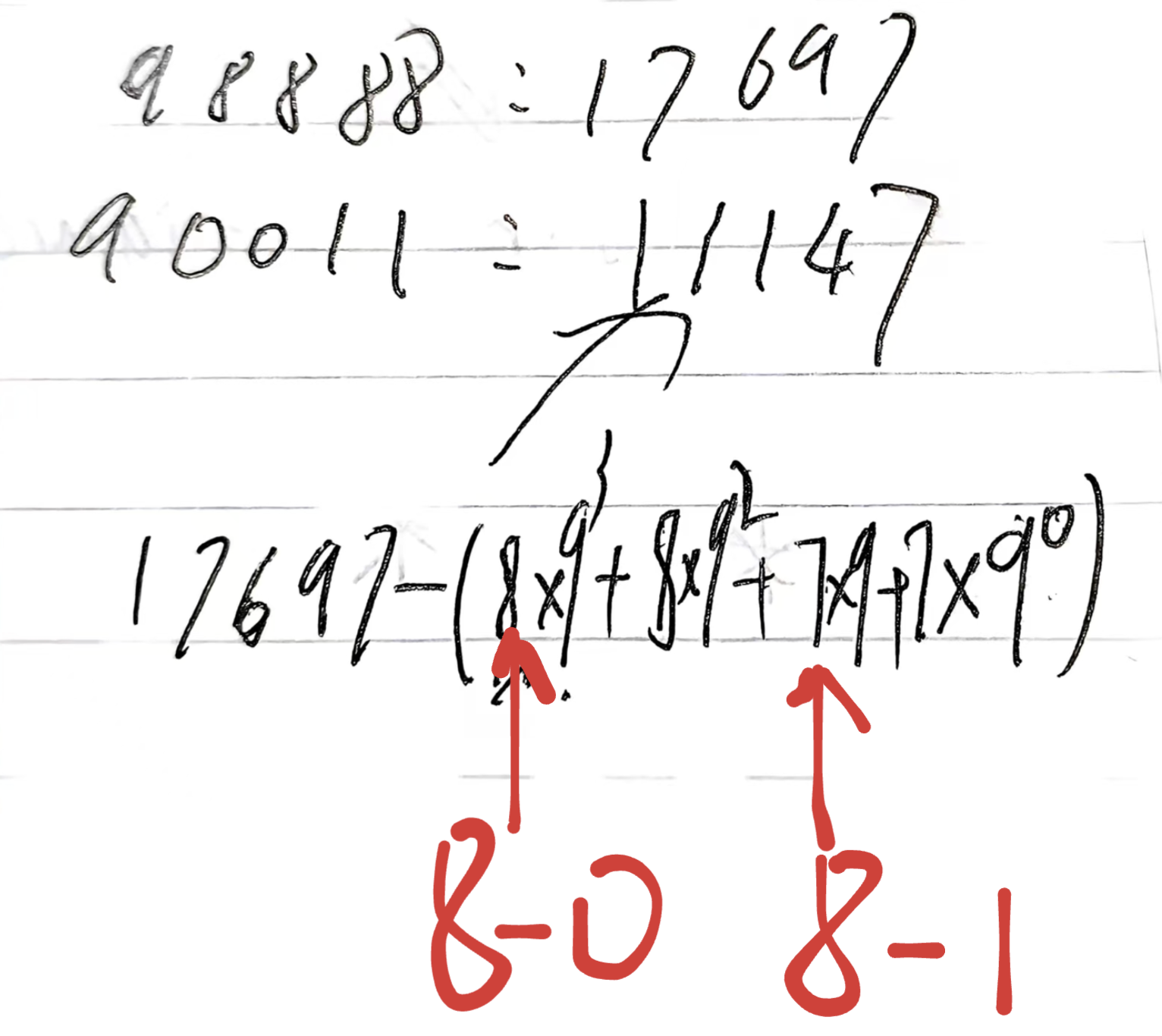
我们以1~90011来解释我们的运算过程

90011可以拆成首位为0~9的情况,其中2~8的计算相对简单,首位已经确定,后面每位有首位种选择,snake number 数量就是 首位^后面的位子数

0的情况就是

1
2
3
4
5
6
7
8
// 假设首位为0情况
if(i==0){
for(int j=0;j<s.size()-1;++j){
for(int k=1;k<=9;++k){
res+=pown[k][j];
}
}
}

9的情况就是和2~8一样正常算,然后把不可行的情况数剪掉

1
2
3
4
5
if(i==s[0]-'0'){
for(int j=0;j<s.size()-1;++j){
res-=(s[0]-'0'-1-(s[s.size()-j-1]-'0'))*pown[i][j];
}
}

具体而言如下图

image

AC代码

AC https://atcoder.jp/contests/abc387/submissions/61678607

1
2
3
4
5
6
7
8
9
10
11
12
13
14
15
16
17
18
19
20
21
22
23
24
25
26
27
28
29
30
31
32
33
34
35
36
37
38
39
40
41
42
43
44
45
46
47
48
49
50
51
52
53
54
55
56
57
58
59
60
61
62
63
64
65
66
67
68
69
70
71
72
73
74
75
76
77
78
79
#include <iostream>
#include <cstring>
#include <algorithm>
#include <deque>
#include <queue>
#include <vector>
#include <set>
#include <map>
#include <unordered_map>
#include <cmath>
#include <bitset>
#include <iterator>
#include <random>
#include <iomanip>
#include <cctype>
#include <array>

using namespace std;

typedef long long ll;
typedef pair<ll,ll> pll;
typedef array<ll,3> arr;
const ll MAXN=static_cast<ll>(2e5)+10;

// dp装的在top位为n的情况下,第i位符合要求的数字数量
ll L,R,digit[25],dp[15][25];
// 为什么要开两维?因为top位不同的情况下,结果没有加和性
// isTop是指该位是不是最高位
ll dfs(ll len,ll isMax,ll top,bool isTop){
if(len==0)
return 1;
if(dp[top][len]!=-1 && !isMax)
return dp[top][len];
ll maxx,res=0;
maxx= isMax ? digit[len]:9;
for(int i=0;i<=maxx && i<top;++i){
if(isTop){
if(i==0){
// top=10 就是指不限制
res+=dfs(len-1,isMax && i==digit[len],10,true);
// 不限制的原因是前导为0,没有资格作首数
}else{
// 是top数,可以改top
res+=dfs(len-1, isMax && i==digit[len], i, false);
}
}else{
// 不是top数,没有资格改top
res+=dfs(len-1, isMax && i==digit[len], top, false);
}
}
if(!isMax)
dp[top][len]=res;
return res;
}

int main()
{
ios::sync_with_stdio(false);
cin.tie(0);cout.tie(0);
cin>>L>>R;
L-=1;
ll idx=0;
while(L){
digit[++idx]=L%10;
L/=10;
}
memset(dp, -1, sizeof(dp));
// 刚传进去该位肯定是最高位
ll lRes=dfs(idx,true,10,true);
idx=0;
while(R){
digit[++idx]=R%10;
R/=10;
}
// memset(dp, -1, sizeof(dp));
ll rRes=dfs(idx,true,10,true);
cout<<rRes-lRes<<'\n';
return 0;
}

AC https://atcoder.jp/contests/abc387/submissions/61423141

1
2
3
4
5
6
7
8
9
10
11
12
13
14
15
16
17
18
19
20
21
22
23
24
25
26
27
28
29
30
31
32
33
34
35
36
37
38
39
40
41
42
43
44
45
46
47
48
49
50
51
52
53
54
55
56
57
58
59
60
61
62
63
64
65
66
67
68
69
70
71
72
73
74
75
76
77
78
79
80
81
82
83
84
85
86
87
88
89
90
91
92
93
94
95
96
97
#include <iostream>
#include <cstring>
#include <algorithm>
#include <deque>
#include <queue>
#include <vector>
#include <set>
#include <map>
#include <cmath>
#include <bitset>
#include <iterator>
#include <random>
#include <iomanip>
#include <cctype>
#include <array>

using namespace std;
typedef unsigned long long ll;
string L,R;
string Ls,Rs;
ll pown[11][21];

void init(){
Ls.assign(L);
Rs.assign(R);
bool isChange=false;
// 通过这种方法可以得到最靠近原数的snake number
for(int i=1;i<Rs.size();++i){
if(Rs[i]<Rs[0] && !isChange){
continue;
}
isChange=true;
Rs[i]=static_cast<char> (Rs[0]-1);
}
isChange=false;
for(int i=1;i<Ls.size();++i){
if(Ls[i]<Ls[0] && !isChange){
continue;
}
isChange=true;
Ls[i]=static_cast<char> (Ls[0]-1);
}
// 通过递推得到pow数组,方便后续计算
for(int i=1;i<=10;++i){
pown[i][0]=1;
for(int j=1;j<=19;++j){
pown[i][j]=i*pown[i][j-1];
}
}
}
inline ll getAns(string &s){
ll res=0;
for(int i=0;i<=s[0]-'0';++i){
// 假设首位为0情况
if(i==0){
for(int j=0;j<s.size()-1;++j){
for(int k=1;k<=9;++k){
res+=pown[k][j];
}
}
}else{
// 首数为i,后面有i^(size-1)种选择
res+=pown[i][s.size()-1];
}
if(i==s[0]-'0'){
for(int j=0;j<s.size()-1;++j){
res-=(s[0]-'0'-1-(s[s.size()-j-1]-'0'))*pown[i][j];
}
}
}
return res;
}

int main()
{
ios::sync_with_stdio(false);
cin.tie(0);cout.tie(0);
cin>>L>>R;
init();
// 先算出1-R,再算出1-L,两者相减
ll Rto1=0,Lto1=0;
Rto1=getAns(Rs);
Lto1=getAns(Ls);
if(L==Ls){
cout<<Rto1-Lto1+1<<endl;
}else{
cout<<Rto1-Lto1<<endl;
}
return 0;
}
/*
AC https://atcoder.jp/contests/abc387/submissions/61423141
29 55

90011 98888

*/

心路历程(WA,TLE,MLE……)