CF-1072-F. Cherry Tree(不要忘记 dp,特别是子问题相互重叠之时) · znzryb
## 题目大意
给定一棵有 n 个顶点的有根树,根节点为 1。每个**叶子节点**上都有一个樱桃。
你需要通过"摇动"顶点来收集所有樱桃。摇动顶点 v 时,所有作为 v 后代的叶子节点上的樱桃都会掉落。**每个叶子的樱桃只能掉落一次,否则树会损坏。**
关键限制:**摇动的****顶点数量****必须是** **3 的倍数**。
问题:是否可能在满足上述条件下收集所有樱桃?
**输入格式:**
- 第一行:测试用例数 t (1 ≤ t ≤ 10⁴)
- 每个测试用例:第一行为 n (2 ≤ n ≤ 2×10⁵),接下来 n-1 行描述树的边
**输出格式:**对每个测试用例输出 "YES" 或 "NO"
## 思路讲解
当你发现一个问题的**子结构之间互相重叠覆盖**,其中还涉及这个**决策**的时候,这个时候,你就要想,**是不是 dp 了。**
树上 dp,定义状态为 $dp_{u,i}$,指的是以 $u$ 为根的子树中,**是否**可以凑出来为这个 $i\ (0,1,2)$ 的这个 3 的余数。
接着问题就来到了如何转移?我们不妨定义,$to$ 为转移过来的子节点,四个你可以理解为 bitset 的东西,长度为 3,$bi$ 为目前的状态,若 $dp_{to,0}$ 为 true,那么 $bi1$ 就是这个 $bi$ 向前循环移动的结果,否则 $bi1$ 为全 0。同理,我们可以定义出 $bi0$,$bi2$。最终经过这个 $to$ 节点的转移后,$bi\gets bi0 \lor bi1 \lor bi2$。(当然,第一个 $to$ 节点转移过来的话,为了初值确定,$bi\gets dp_{to}$)
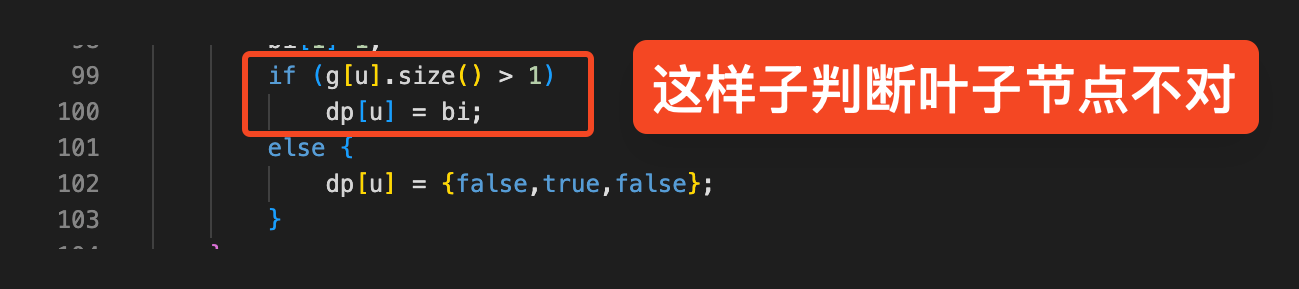
最后,令 $bi_1\gets \text{true}$(因为我们始终可以选择子树根节点,来解决这个问题),接着 $dp_u\gets bi$。
为什么要这么转移?我们会发现,就是说如果子树只有一个唯一的位移的话,是不是只是让这个状态进行一个位移?那么其实只有一个位移是没什么大用的,但是如果有两种位移?三种位移?这几种位移之间如何组合?那么答案就昭然若揭了。
## AC代码
AC
[https://codeforces.com/contest/2184/submission/357994744](https://codeforces.com/contest/2184/submission/357994744)
::: 源代码
```cpp
/**
* Problem: F. Cherry Tree
* Contest: Codeforces Round 1072 (Div. 3)
* Judge: Codeforces
* URL: https://codeforces.com/contest/2184/problem/F
* Created: 2026-01-15 14:06:26
* Author: Gospel_rock
*/
#include <bits/stdc++.h>
#include <ranges>
#define all(vec) vec.begin(),vec.end()
#define lson(o) (o<<1)
#define rson(o) (o<<1|1)
#define SZ(a) ((long long) a.size())
#define debug(var) cerr << #var <<":"<<var<<"\n";
#define cend cerr<<"\n-----------\n"
#define fsp(x) fixed<<setprecision(x)
using namespace std;
using ll = long long;
using ull = unsigned long long;
using DB = double;
using LD = long double;
// using i128 = __int128;
using CD = complex<double>;
static constexpr ll MAXN = (ll)1e6+10, INF = (1ll<<61)-1;
static constexpr ll mod = 998244353; // (ll)1e9+7;
static constexpr double eps = 1e-8;
const double pi = acos(-1.0);
ll lT;
/*
*
*/
void Solve() {
ll N;
cin >> N;
vector<vector<ll>> g(N+2);
for (int i=1;i<=N-1;++i) {
ll u,v;
cin>>u>>v;
g[u].push_back(v);
g[v].push_back(u);
}
vector<vector<int>> dp(N+2,vector<int>(3));
auto dfs=[&](auto && self,ll u,ll p) -> void {
vector<int> bi(3);
// 循环左移
auto left_move=[&](ll x) {
vector<int> res(3);
for (int i=0;i<3;++i) {
res[(i+x)%3]=bi[i];
}
return res;
};
auto fun_or=[&](vector<int> a,vector<int> b) {
for (int i=0;i<3;++i) {
a[i]|=b[i];
}
return a;
};
int cnt = 0;
for (auto v:g[u]) {
if (v==p) continue;
self(self,v,u);
if (cnt == 0) {
bi=dp[v];
cnt++;
continue;
}
vector<int> bi1(3),bi2(3),bi0(3);
if (dp[v][0]) {
bi0=left_move(0);
}
if (dp[v][1]) {
bi1=left_move(1);
}
if (dp[v][2]) {
bi2=left_move(2);
}
bi=fun_or(bi0,fun_or(bi1,bi2));
}
bi[1]=1;
dp[u]=bi;
};
dfs(dfs,1,0);
cout << (dp[1][0] ? "YES\n":"NO\n");
}
signed main() {
ios::sync_with_stdio(false);
cin.tie(nullptr);
cout.tie(nullptr);
cin >> lT;
while(lT--)
Solve();
return 0;
}
/*
AC
https://codeforces.com/contest/2184/submission/357994744
*/
```
:::
## 心路历程(WA,TLE,MLE……)