基本情况
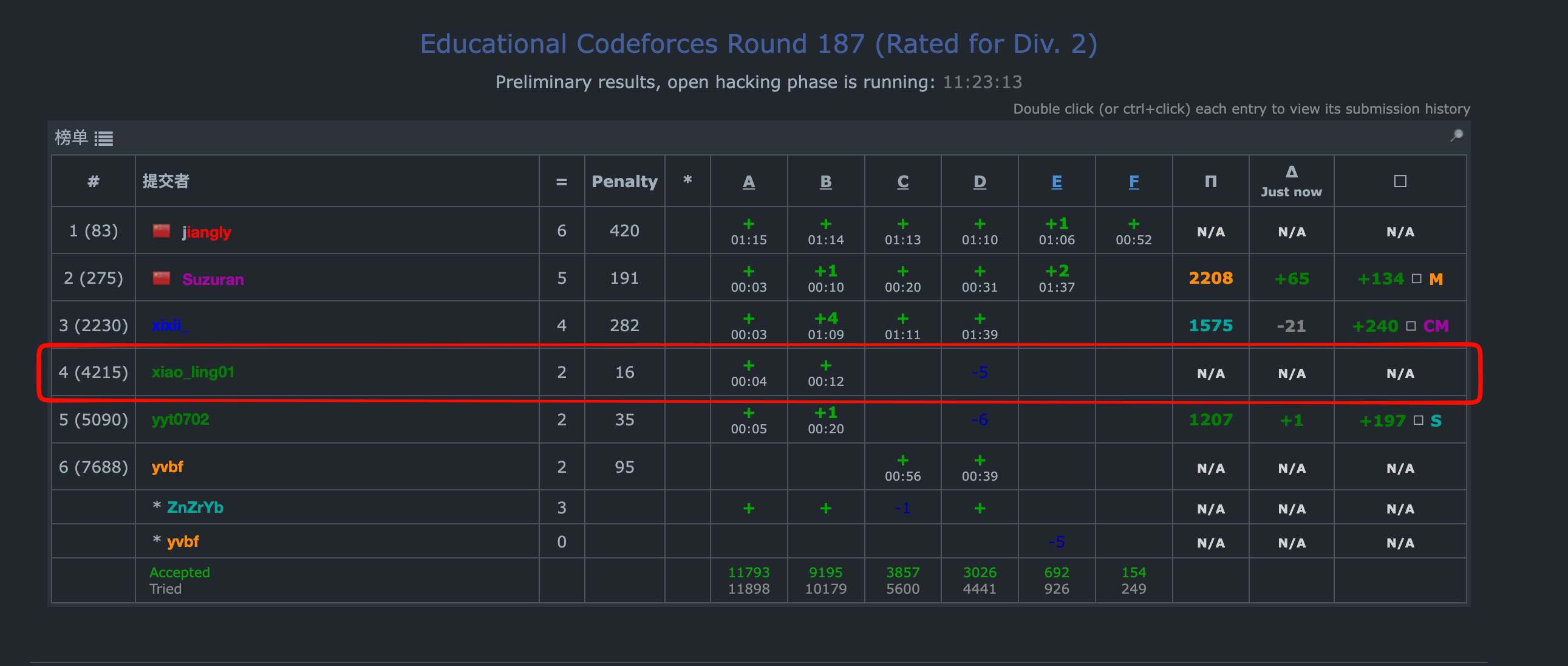
两道题目,哎,还好这个B做的快是吧,绷不住了。
当然了,小号其实也无所谓。嗯,其实也还好不过之后呢,我觉得还是把这个号打上去以后,还是用这个号打。其实,你一直没分数,其实也没什么意思,就是那种比较刺激的那种感觉是吧。
OK,我们说回来。这个D为什么交了5发还是没过呢?主要是因为就是这个D,它的数据量比较大。使用Victor victor或者victor的这种调和级数写法呢,它这个时间会超。可以使用vis 数组标记所有 a 的倍数。这样子可以避免卡常。
1
2
3
4
5
6
7
8
9
10
| ll cnt_un_divide=0,cnt_all_divide=0;
vector<char> vis(N+M+2);
for (auto a:A) {
for (ll i=1;i<=N+M;++i) {
if (i*a>N+M) {
break;
}
vis[i*a]=true;
}
}
|
然后为什么标题里面提了不要用 while 循环?是因为涉及累加的逻辑(在 D 的对拍暴力程序当中),直接 continue 以后,while 循环的这个累加就崩掉了。
A 就是一个向上取整除法,没什么好说的。
A 源代码
1
2
3
4
5
6
7
8
9
10
11
12
13
14
15
16
17
18
19
20
21
22
23
24
25
26
27
28
29
30
31
32
33
34
35
36
37
38
39
40
41
42
43
44
45
46
47
48
49
50
51
52
53
54
55
56
57
58
59
60
61
62
63
64
65
66
67
68
69
70
71
72
73
74
75
76
77
78
79
|
#include <bits/stdc++.h>
#define all(vec) vec.begin(),vec.end()
#define lson(o) (o<<1)
#define rson(o) (o<<1|1)
#define SZ(a) ((long long) a.size())
#define debug(var) cerr << #var <<" = ["<<var<<"]"<<"\n";
#define debug1d(a) \
cerr << #a << " = ["; \
for (int i = 0; i < (int)(a).size(); i++) \
cerr << (i ? ", " : "") << a[i]; \
cerr << "]\n";
#define debug2d(a) \
cerr << #a << " = [\n"; \
for (int i = 0; i < (int)(a).size(); i++) \
{ \
cerr << " ["; \
for (int j = 0; j < (int)(a[i]).size(); j++) \
cerr << (j ? ", " : "") << a[i][j]; \
cerr << "]\n"; \
} \
cerr << "]\n";
#define cend cerr<<"\n-----------\n"
#define fsp(x) fixed<<setprecision(x)
using namespace std;
using ll = long long;
using ull = unsigned long long;
using DB = double;
using CD = complex<double>;
static constexpr ll MAXN = (ll)1e6+10, INF = (1ll<<61)-1;
static constexpr ll mod = 998244353;
static constexpr double eps = 1e-8;
const double pi = acos(-1.0);
ll lT,testcase;
void Solve() {
ll N,M,D;
cin >> N >> M >> D;
ll ans=(N+D/M)/(D/M+1);
cout<<ans<<"\n";
}
signed main() {
ios::sync_with_stdio(false);
cin.tie(nullptr);
cout.tie(nullptr);
#ifdef LOCAL
cout.setf(ios::unitbuf);
#endif
cin >> lT;
for (testcase=1;testcase<=lT;++testcase)
Solve();
return 0;
}
|
B 也简单,就是猜一下,我猜,只有这个 digit 总和小于 10 的情况下,题设条件才成立。注意前导 0,不要不小心进行操作后出现前导 0。
可以在排序前,对第一个数减 1,让其被操作后至少保留 1。
1
2
| sn[0]--;
sort(all(sn),greater<>());
|
B 源代码
1
2
3
4
5
6
7
8
9
10
11
12
13
14
15
16
17
18
19
20
21
22
23
24
25
26
27
28
29
30
31
32
33
34
35
36
37
38
39
40
41
42
43
44
45
46
47
48
49
50
51
52
53
54
55
56
57
58
59
60
61
62
63
64
65
66
67
68
69
70
71
72
73
74
75
76
77
78
79
80
81
82
83
84
85
86
87
88
89
90
91
92
93
94
95
96
97
98
|
#include <bits/stdc++.h>
#define all(vec) vec.begin(),vec.end()
#define lson(o) (o<<1)
#define rson(o) (o<<1|1)
#define SZ(a) ((long long) a.size())
#define debug(var) cerr << #var <<" = ["<<var<<"]"<<"\n";
#define debug1d(a) \
cerr << #a << " = ["; \
for (int i = 0; i < (int)(a).size(); i++) \
cerr << (i ? ", " : "") << a[i]; \
cerr << "]\n";
#define debug2d(a) \
cerr << #a << " = [\n"; \
for (int i = 0; i < (int)(a).size(); i++) \
{ \
cerr << " ["; \
for (int j = 0; j < (int)(a[i]).size(); j++) \
cerr << (j ? ", " : "") << a[i][j]; \
cerr << "]\n"; \
} \
cerr << "]\n";
#define cend cerr<<"\n-----------\n"
#define fsp(x) fixed<<setprecision(x)
using namespace std;
using ll = long long;
using ull = unsigned long long;
using DB = double;
using CD = complex<double>;
static constexpr ll MAXN = (ll)1e6+10, INF = (1ll<<61)-1;
static constexpr ll mod = 998244353;
static constexpr double eps = 1e-8;
const double pi = acos(-1.0);
ll lT,testcase;
void Solve() {
ll N;
cin >> N;
string sn=to_string(N);
ll sum=0;
for (auto ch:sn) {
sum+=ch-'0';
}
sn[0]--;
sort(all(sn),greater<>());
ll ans=0;
if (sum<10) {
cout<<ans<<"\n";
return;
}
for (auto ch:sn) {
ll num=ch-'0';
sum-=num;
++ans;
if (sum<10) {
cout<<ans<<"\n";
return;
}
}
}
signed main() {
ios::sync_with_stdio(false);
cin.tie(nullptr);
cout.tie(nullptr);
#ifdef LOCAL
cout.setf(ios::unitbuf);
#endif
cin >> lT;
for (testcase=1;testcase<=lT;++testcase)
Solve();
return 0;
}
|
心得感悟