题目描述 x = 0 x=0 x = 0 n n n i i i a i a_i a i b i b_i b i 只有当当前 rating x ≤ a i x \le a_i x ≤ a i 时,Capoo 才能参加第 i i i 场比赛。参加完该场比赛后,Capoo 的 rating 将会更新为 max ( b i , x ) \max(b_i, x) max ( b i , x ) 。 n n n
输入格式 n n n 1 ≤ n ≤ 1 0 6 1 \le n \le 10^6 1 ≤ n ≤ 1 0 6 n n n a i a_i a i b i b_i b i 0 ≤ a i , b i ≤ 1 0 18 0 \le a_i, b_i \le 10^{18} 0 ≤ a i , b i ≤ 1 0 1 8 i i i
输出格式
样例
1
2
3
4
5
6
7
8
9
10
11
12
13
14
15
输入: 10 19 18 6 15 5 8 4 20 18 3 16 9 0 7 5 17 2 13 15 17 输出: 5
样例解释
注意,这个人比较喜欢挑战这个难题。 5 5 5
初始时 x = 0 x = 0 x = 0
参加第 7 7 7 a 7 = 0 , b 7 = 7 a_7=0, b_7=7 a 7 = 0 , b 7 = 7 x ≤ a 7 x \le a_7 x ≤ a 7 0 ≤ 0 0 \le 0 0 ≤ 0 x x x max ( 0 , 7 ) = 7 \max(0, 7) = 7 max ( 0 , 7 ) = 7
参加第 5 5 5 a 5 = 18 , b 5 = 3 a_5=18, b_5=3 a 5 = 1 8 , b 5 = 3 x ≤ a 5 x \le a_5 x ≤ a 5 7 ≤ 18 7 \le 18 7 ≤ 1 8 x x x max ( 7 , 3 ) = 7 \max(7, 3) = 7 max ( 7 , 3 ) = 7
参加第 6 6 6 a 6 = 16 , b 6 = 9 a_6=16, b_6=9 a 6 = 1 6 , b 6 = 9 x ≤ a 6 x \le a_6 x ≤ a 6 7 ≤ 16 7 \le 16 7 ≤ 1 6 x x x max ( 7 , 9 ) = 9 \max(7, 9) = 9 max ( 7 , 9 ) = 9
参加第 10 10 1 0 a 10 = 15 , b 10 = 17 a_{10}=15, b_{10}=17 a 1 0 = 1 5 , b 1 0 = 1 7 x ≤ a 10 x \le a_{10} x ≤ a 1 0 9 ≤ 15 9 \le 15 9 ≤ 1 5 x x x max ( 9 , 17 ) = 17 \max(9, 17) = 17 max ( 9 , 1 7 ) = 1 7
参加第 1 1 1 a 1 = 19 , b 1 = 18 a_1=19, b_1=18 a 1 = 1 9 , b 1 = 1 8 x ≤ a 1 x \le a_1 x ≤ a 1 17 ≤ 19 17 \le 19 1 7 ≤ 1 9 x x x max ( 17 , 18 ) = 18 \max(17, 18) = 18 max ( 1 7 , 1 8 ) = 1 8 5 5 5
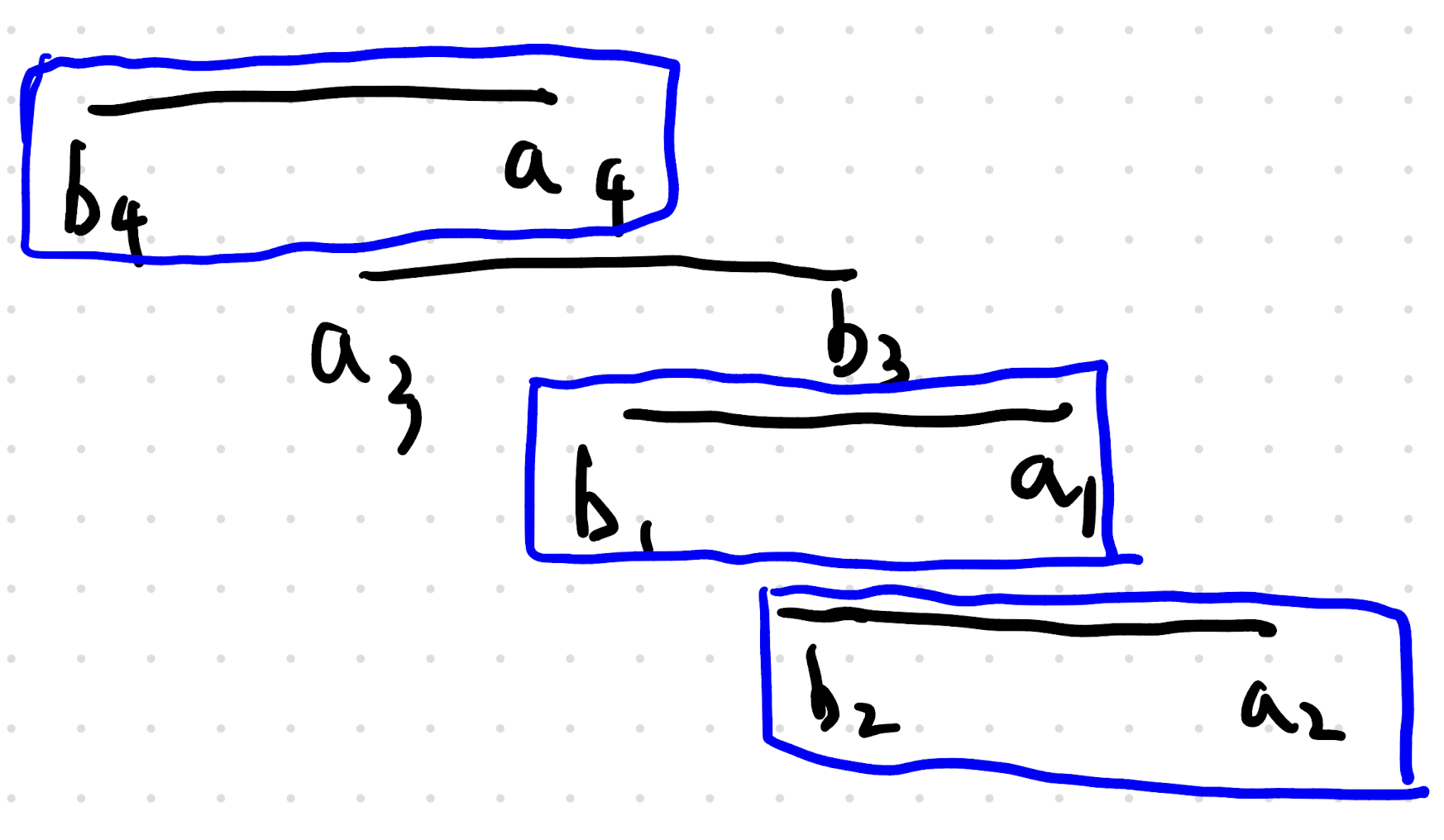
将所有比赛分成两组:
安全组 A :b i ≤ a i b_i \le a_i b i ≤ a i x ← max ( x , b i ) ≤ a i x \leftarrow \max(x, b_i) \le a_i x ← max ( x , b i ) ≤ a i x x x a i a_i a i
危险组 B :b i > a i b_i > a_i b i > a i x x x b i b_i b i b i > a i ≥ x b_i > a_i \ge x b i > a i ≥ x
为什么这个分组有用?因为安全组内部,如果按 a i a_i a i 升序排列,全部都能参加 ——每次参加后 x ≤ a i x \le a_i x ≤ a i a a a
下一步应该关注:安全组全做了,危险组怎么尽可能多地塞进来 **?(把安全组给固定住)**
第三层:排序与交错——两组的最优合并策略
一下的这个规则就是,在上面情况下,B 不会影响 A ?(先不要去想 B 会不会生效 )
关键的交错规则:在做每一个危险组比赛 B j B_j B j ( b b b 值为 b j b_j b j )之前,先把安全组中所有 a i < b j a_i < b_j a i < b j 的比赛做完。
为什么?做完 B j B_j B j x = b j x = b_j x = b j a < b j a < b_j a < b j x x x b ≤ a < b j b \le a < b_j b ≤ a < b j B j B_j B j
这样,安全组的比赛一场都不会浪费 ——它们总是在 x x x
安全组全部 + 按上述交错策略能做的危险组数量 \text{安全组全部} + \text{按上述交错策略能做的危险组数量}
安全组全部 + 按上述交错策略能做的危险组数量
不难想到,危险组按照这个 b 从小到大排比较好,
1
2
3
4
5
6
7
8
9
10
11
12
13
14
15
16
17
18
auto forward=[&]() -> bool { while (idx1<SZ (safeA) && idx2<SZ (dangerA) && safeA[idx1].a<dangerA[idx2].b) { cur_ability=max (cur_ability,safeA[idx1].b); ++idx1; } if (cur_ability<=dangerA[idx2].a) { cur_ability=max (cur_ability,dangerA[idx2].b); ++ans; } ++idx2; if (idx2<SZ (dangerA)) { return true ; } return false ; }; while (forward()) {}
源代码
1 2 3 4 5 6 7 8 9 10 11 12 13 14 15 16 17 18 19 20 21 22 23 24 25 26 27 28 29 30 31 32 33 34 35 36 37 38 39 40 41 42 43 44 45 46 47 48 49 50 51 52 53 54 55 56 57 58 59 60 61 62 63 64 65 66 67 68 69 70 71 72 73 74 75 76 77 78 79 80 81 82 83 84 85 86 87 88 89 90 91 92 93 94 95 96 97 98 99 100 101 102 103 104 105 106 107 108 109 110 111 112 113 114 115 116 117 118 119 120 121 122 123 124 125 126 127 128 129 130 131 132 133 134 135 136 137 138 139 140 141 142 143 144 145 146 147 148 149 #include <bits/stdc++.h> #define all(vec) vec.begin(),vec.end() #define lson(o) (o<<1) #define rson(o) (o<<1|1) #define SZ(a) ((long long) a.size()) #define debug(var) cerr << #var <<" = [" <<var<<"]" <<"\n" ; #define debug1d(a) \ cerr << #a << " = [" ; \ for (int i = 0; i < (int)(a).size(); i++) \ cerr << (i ? ", " : "" ) << a[i]; \ cerr << "]\n" ; #define debug2d(a) \ cerr << #a << " = [\n" ; \ for (int i = 0; i < (int)(a).size(); i++) \ { \ cerr << " [" ; \ for (int j = 0; j < (int)(a[i]).size(); j++) \ cerr << (j ? ", " : "" ) << a[i][j]; \ cerr << "]\n" ; \ } \ cerr << "]\n" ; #define cend cerr<<"\n-----------\n" #define fsp(x) fixed<<setprecision(x) using namespace std;using ll = long long ;using ull = unsigned long long ;using DB = double ;using i128 = __int128;using CD = complex<double >;static constexpr ll MAXN = (ll)1e6 +10 , INF = (1ll <<61 )-1 ;static constexpr ll mod = 998244353 ; static constexpr double eps = 1e-8 ;const double pi = acos (-1.0 );ll lT,testcase; struct A_b { ll a,b; }; struct Cmp { bool operator () (const A_b &a,const A_b &b) const if (a.a!=b.a) return a.a<b.a; return a.b>b.b; } }; struct Cmp2 { bool operator () (const A_b &a,const A_b &b) const if (a.b!=b.b) return a.b<b.b; return a.a<b.a; } }; void Solve () ll N; cin >> N; vector<A_b> safeA,dangerA; for (int i=1 ;i<=N;++i) { ll a,b; cin>>a>>b; if (a>=b) { safeA.push_back ({a,b}); }else { dangerA.push_back ({a,b}); } } ll ans=SZ (safeA); sort (all (safeA),Cmp ()); sort (all (dangerA),Cmp2 ()); ll idx1=0 ,idx2=0 ; ll cur_ability=0 ; #ifdef LOCAL for (int i=0 ;i<SZ (safeA);++i) { debug (i); debug (safeA[i].a); debug (safeA[i].b); } cend; for (int i=0 ;i<SZ (dangerA);++i) { debug (i); debug (dangerA[i].a); debug (dangerA[i].b); } cend; #endif auto forward=[&]() -> bool { while (idx1<SZ (safeA) && idx2<SZ (dangerA) && safeA[idx1].a<dangerA[idx2].b) { cur_ability=max (cur_ability,safeA[idx1].b); ++idx1; } if (cur_ability<=dangerA[idx2].a) { cur_ability=max (cur_ability,dangerA[idx2].b); ++ans; } #ifdef LOCAL debug (idx1); debug (idx2); debug (ans); debug (cur_ability); debug (dangerA[idx2].a); debug (dangerA[idx2].b); #endif ++idx2; if (idx2<SZ (dangerA)) { return true ; } return false ; }; while (forward()) { } cout<<ans<<"\n" ; } signed main () ios::sync_with_stdio (false ); cin.tie (nullptr ); cout.tie (nullptr ); #ifdef LOCAL cout.setf (ios::unitbuf); #endif Solve (); return 0 ; }