1
2
3
4
5
6
7
8
9
10
11
12
13
14
15
16
17
18
19
20
21
22
23
24
25
26
27
28
29
30
31
32
33
34
35
36
37
38
39
40
41
42
43
44
45
46
47
48
49
50
51
52
53
54
55
56
57
58
59
60
61
62
63
64
65
66
67
68
69
70
71
72
73
74
75
76
77
78
79
80
81
82
83
84
85
86
87
88
89
90
91
92
93
94
95
96
97
98
99
100
101
102
103
104
105
106
107
108
109
110
111
112
113
114
115
116
117
118
119
120
121
122
123
124
125
126
127
128
129
130
131
132
133
134
135
136
137
138
139
140
141
142
143
144
145
146
147
148
149
150
151
152
153
154
155
156
157
158
159
160
161
162
163
164
165
166
167
168
169
170
171
172
173
174
175
176
177
178
179
180
181
182
183
184
| \documentclass{article}
\usepackage{graphicx}
\usepackage{amsmath}
\usepackage{amssymb}
\usepackage{xeCJK}
\usepackage{multicol}
\usepackage{tocloft}
\usepackage{xcolor}
\usepackage[cachedir=_minted-main]{minted}
\usepackage[a4paper, left=2cm, right=2cm, top=2.5cm, bottom=2.5cm]{geometry}
\usepackage{tikz}
\setminted{
breaklines=true,
breakanywhere=true,
fontsize=\small,
frame=single,
bgcolor=gray!5,
tabsize=2,
}
\renewcommand{\cftsecleader}{\cftdotfill{\cftdotsep}}
\usepackage[colorlinks=true, linkcolor=black, anchorcolor=black, citecolor=black, filecolor=black, menucolor=black, runcolor=black, urlcolor=blue]{hyperref}
\definecolor{arcA}{RGB}{220,80,60}
\definecolor{arcB}{RGB}{50,120,200}
\definecolor{barrier}{RGB}{255,160,0}
\definecolor{pathc}{RGB}{0,160,80}
\title{1001 布布吃地瓜 题解}
\author{Gospel\_rock}
\date{}
\begin{document}
\maketitle
\section{题意}
给定一个 $n \times m$ 的网格,格子 $(i,j)$ 上写着整数 $a_{i,j}$。
从 $(1,1)$ 出发,经四连通移动到 $(n,m)$,不能离开网格。
令 $S$ 为路径上所有格子中整数构成的集合,求所有合法路径中 $\text{mex}(S)$ 的最小值。
\section{核心观察:路径—屏障对偶}
问题等价于:对每个非负整数 $k$,判断是否\textbf{每条} $(1,1) \to (n,m)$ 的四连通路径都必须经过至少一个值为 $k$ 的格子。如果是,则 $k$ 一定在集合 $S$ 中(称 $k$ 为\textbf{不可避免的});否则存在某条路径绕开所有值为 $k$ 的格子(称 $k$ 为\textbf{可避免的})。答案即为最小的可避免值。
判断 $k$ 是否不可避免,依赖于网格上\textbf{路径与屏障的对偶性}——这是离散 Jordan 曲线定理在网格图上的直接推论。
\subsection{边界弧的划分}
将网格的边界沿周长分为两段弧,以 $(1,1)$ 和 $(n,m)$ 为分界点(如图~\ref{fig:arc}):
\begin{itemize}
\item \textbf{弧 $\boldsymbol{A}$}(红色):从 $(1,1)$ 沿顶边向右到 $(1,m)$,再沿右边向下到 $(n,m)$。
\item \textbf{弧 $\boldsymbol{B}$}(蓝色):从 $(1,1)$ 沿左边向下到 $(n,1)$,再沿底边向右到 $(n,m)$。
\end{itemize}
\begin{figure}[htbp]
\centering
\begin{tikzpicture}[scale=0.9]
\foreach \i in {0,...,5} {
\draw[gray!40] (\i,0) -- (\i,4);
}
\foreach \j in {0,...,4} {
\draw[gray!40] (0,\j) -- (5,\j);
}
\draw[arcA, line width=3pt] (0,4) -- (5,4);
\draw[arcA, line width=3pt] (5,4) -- (5,0);
\draw[arcB, line width=3pt] (0,4) -- (0,0);
\draw[arcB, line width=3pt] (0,0) -- (5,0);
\fill[black] (0,4) circle (4pt) node[above left] {$(1,1)$};
\fill[black] (5,0) circle (4pt) node[below right] {$(n,m)$};
\draw[arcA, line width=2.5pt] (6.2,3.8) -- (7.2,3.8) node[right, black] {弧 $A$};
\draw[arcB, line width=2.5pt] (6.2,3.0) -- (7.2,3.0) node[right, black] {弧 $B$};
\end{tikzpicture}
\caption{边界弧的划分。$(1,1)$ 和 $(n,m)$ 将网格边界分成红、蓝两段弧。}
\label{fig:arc}
\end{figure}
\subsection{对偶定理}
\begin{quote}
\textbf{定理(网格路径—屏障对偶)}\;
在 $n \times m$ 的网格中,不存在从 $(1,1)$ 到 $(n,m)$ 的四连通路径能完全避开值为 $k$ 的格子,当且仅当值为 $k$ 的格子中存在一个\textbf{八连通}连通分量,同时触及弧 $A$ 和弧 $B$。
\end{quote}
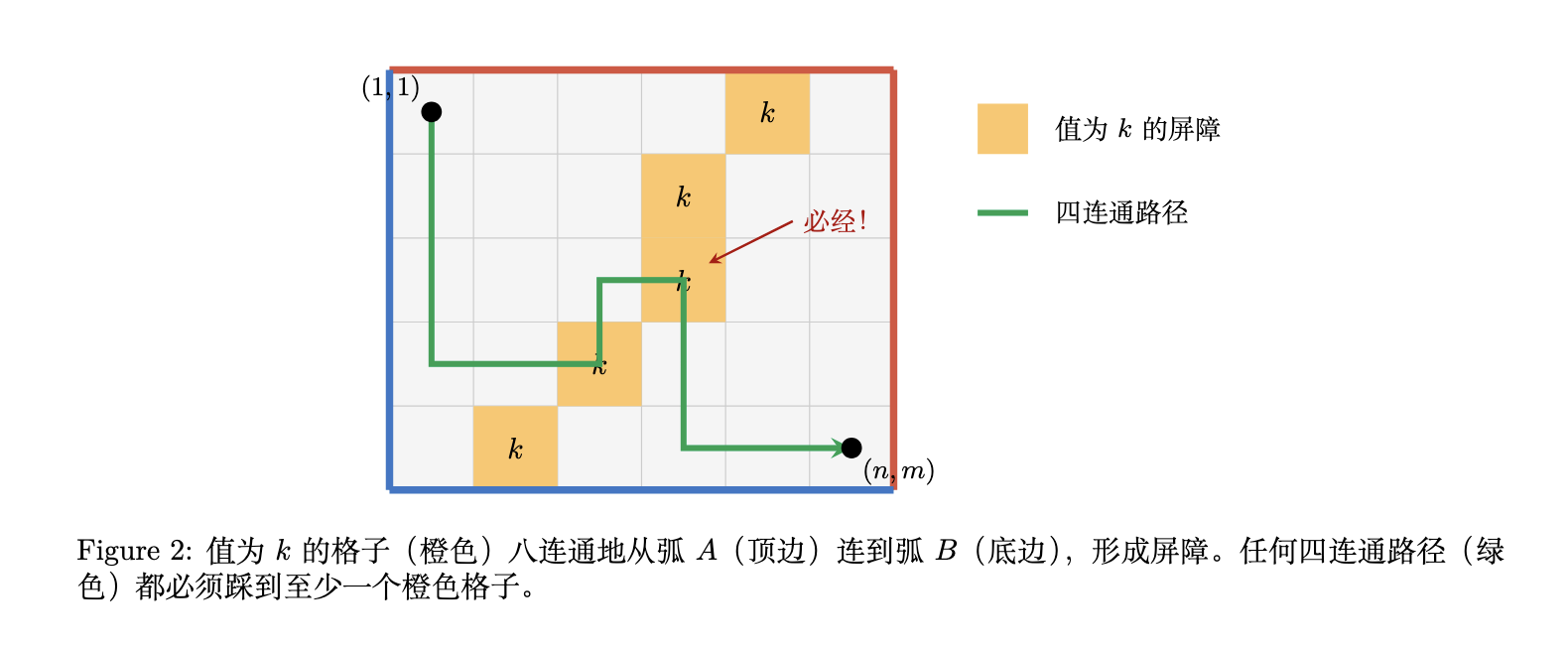
直觉上很好理解:任何一条从 $(1,1)$ 到 $(n,m)$ 的四连通路径,都会将网格"切割"为两部分——一部分靠近弧 $A$,另一部分靠近弧 $B$。若一群同值格子八连通地从弧 $A$ 连到弧 $B$,则这群格子构成了一道"墙",任何四连通路径都无法从"墙"的缝隙中穿过(四连通无法斜穿八连通的间隙),因此必须踩到墙上。
图~\ref{fig:barrier} 展示了一个具体例子。
\begin{figure}[htbp]
\centering
\begin{tikzpicture}[scale=1.0]
\foreach \i in {0,...,5} {
\foreach \j in {0,...,4} {
\fill[gray!8] (\i,\j) rectangle ++(1,1);
}
}
\foreach \i in {0,...,6} {
\draw[gray!40] (\i,0) -- (\i,5);
}
\foreach \j in {0,...,5} {
\draw[gray!40] (0,\j) -- (6,\j);
}
\foreach \x/\y in {4/4, 3/3, 3/2, 2/1, 1/0} {
\fill[barrier!60] (\x,\y) rectangle ++(1,1);
\node[font=\bfseries] at (\x+0.5,\y+0.5) {$k$};
}
\draw[arcA, line width=2.5pt] (0,5) -- (6,5);
\draw[arcA, line width=2.5pt] (6,5) -- (6,0);
\draw[arcB, line width=2.5pt] (0,5) -- (0,0);
\draw[arcB, line width=2.5pt] (0,0) -- (6,0);
\draw[pathc, line width=2pt, -stealth]
(0.5,4.5) -- (0.5,3.5) -- (0.5,2.5) -- (0.5,1.5)
-- (1.5,1.5) -- (2.5,1.5) -- (2.5,2.5)
-- (3.5,2.5)
-- (3.5,1.5) -- (3.5,0.5)
-- (4.5,0.5) -- (5.5,0.5);
\fill[black] (0.5,4.5) circle (3.5pt);
\node[above left, font=\small] at (0.5,4.5) {$(1,1)$};
\fill[black] (5.5,0.5) circle (3.5pt);
\node[below right, font=\small] at (5.5,0.5) {$(n,m)$};
\draw[-stealth, thick, red!70!black] (4.8,3.2) -- (3.8,2.7);
\node[right, font=\small, red!70!black] at (4.8,3.2) {必经!};
\fill[barrier!60] (7,4) rectangle ++(0.6,0.6);
\node[right, font=\small] at (7.8,4.3) {值为 $k$ 的屏障};
\draw[pathc, line width=2pt] (7,3.3) -- (7.6,3.3);
\node[right, font=\small] at (7.8,3.3) {四连通路径};
\end{tikzpicture}
\caption{值为 $k$ 的格子(橙色)八连通地从弧 $A$(顶边)连到弧 $B$(底边),形成屏障。任何四连通路径(绿色)都必须踩到至少一个橙色格子。}
\label{fig:barrier}
\end{figure}
\section{算法流程}
根据对偶定理,算法只需逐一判断每个值是否构成屏障即可。
\begin{enumerate}
\item 将候选集合 $C \leftarrow \{0, 1, 2, \ldots, n + m\}$。
\item 枚举弧 $A$ 上的每个格子 $(i,j)$(即第 $1$ 行的所有格子与第 $m$ 列的所有格子),
对尚未访问的格子发起\textbf{八连通 DFS},仅扩展值相同的邻居。
\item 若 DFS 过程中到达了弧 $B$ 上的某个格子(即第 $1$ 列或第 $n$ 行),
说明当前值 $v$ 构成屏障,从 $C$ 中删除 $v$。
\item 所有弧 $A$ 上的格子处理完毕后,$C$ 中的最小元素即为答案。
\end{enumerate}
为什么只需从弧 $A$ 出发搜索?因为屏障必须\textbf{同时}触及弧 $A$ 与弧 $B$,从弧 $A$ 出发的同值连通分量若能到达弧 $B$,就恰好满足此条件。
\subsection{复杂度分析}
每个格子至多被访问一次(DFS 中标记 \texttt{vis}),因此总时间复杂度为 $O(nm)$,空间复杂度为 $O(nm)$。
\section{AC 代码}
\inputminted{cpp}{../src/1001_2.cpp}
\end{document}
|